




Sometimes, the biggest reason to change a finance process is surprisingly small.
Take an Italian business with around 200 employees. Whenever a company credit card expired, someone had to visit the bank to collect its replacement in person. It was a routine task, accepted as part of the job, until the company finally decided it had had enough.
Or consider a small UK surveying firm whose employees had to call the bank whenever they needed to change a card limit. Frustrating for the person waiting to make a purchase, and equally frustrating for the administrator trying to help them.
Neither business was dealing with a major financial crisis. They were simply losing time to processes that had become so familiar nobody questioned them anymore.
Over the past few weeks, I explored the hidden cost of these everyday frustrations through 53 interviews with Soldo customers, looking at what prompted them to change how they manage company spending.
I expected to hear about digital transformation strategies, efficiency targets and carefully planned technology investments. Instead, I heard stories about bank visits, missing receipts, reimbursement headaches and finance teams spending hours helping employees make simple purchases.
What became clear is that many businesses only recognise the true cost of an outdated process when it becomes too painful to ignore.
The hidden cost of everyday finance processes
Every business has processes that people accept because they’ve always worked that way. An employee needs access to company money, so they contact finance. Someone needs to increase a spending limit, so they wait for approval. A receipt goes missing, so another person spends time tracking it down.
Individually, these tasks rarely seem important enough to warrant a major change. Collectively, they can consume an extraordinary amount of time.
One of the more interesting findings was how differently employees and finance teams experience company spending. Employees need to make purchases when the work demands it, while finance needs to account for those purchases, ensure compliance and keep budgets under control. Both have legitimate priorities, yet they often operate on completely different timelines.
One UK education provider described an employee standing at a till without enough money on their company card. They called the office, finance topped up the card while they were still on the phone, and the payment went through. An Italian industrial maintenance company shared a similar example, where a manager created a virtual card so an employee could urgently purchase supplies at an international site.
These situations might sound ordinary, yet having immediate access to funds made the difference between completing the job and facing another delay.
In fact, 16 of the 53 customers interviewed identified instant access to funds as the benefit they valued most, making it the most frequently mentioned benefit in the research.
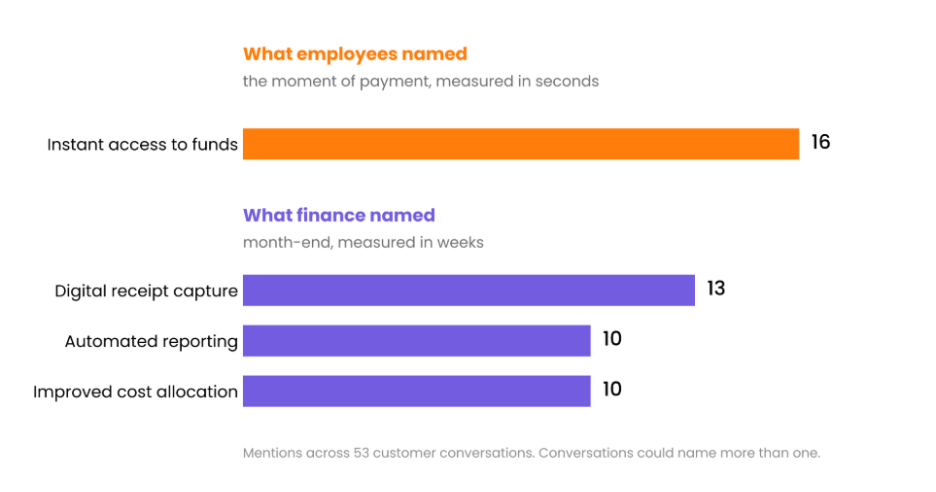
Finance teams tended to highlight different improvements, with thirteen customers mentioning digital receipt capture and ten each identifying automated reporting and better cost allocation.
When employees can access funds quickly, work keeps moving. When finance can track transactions as they happen, it spends less time chasing information later. Both sides benefit when the process works properly.
When one transaction takes an hour
One of the most striking examples came from an organisation managing spending across more than 400 student groups and sports societies.
These groups needed to pay for everyday things such as uniforms, venues and coaches, yet under the organisation’s previous process, a single transaction required approximately one hour of finance staff time. Students couldn’t complete purchases independently, so someone from finance had to guide them through the payment process.
Now imagine each of those 400 groups makes just one transaction per academic term. Across three terms, that’s more than 1,200 hours of finance time every year, based on a conservative illustration rather than the organisation’s actual transaction volume.
Those hours could have been spent improving forecasts, analysing costs or helping departments make better decisions. Instead, finance was effectively responsible for getting every everyday purchase over the line.
I’ve seen this challenge come up repeatedly in conversations with finance leaders. Businesses invest in sophisticated reporting and planning systems, yet the processes that determine how employees actually access and spend company money often remain manual.
If you’re looking for opportunities to improve finance productivity, that’s a pretty good place to start.
Why employees shouldn’t have to fund company spending
Another recurring theme was the reliance on employees paying for business expenses with their own money, something nine of the 53 customers raised during their interviews.
One customer described an employee who had accumulated hundreds of pounds in business expenses using personal funds. While waiting for reimbursement, they began experiencing cash flow difficulties.
Think about how strange this arrangement really is. Imagine asking an employee to lend the company several hundred pounds for a month, with a promise to repay them later. Most businesses would find that unreasonable, yet when employees pay for travel, accommodation or supplies themselves, we often treat it as perfectly normal.
The consequences extend beyond inconvenience. Employees may hesitate before making necessary purchases, delay spending until they can afford it or avoid certain expenses altogether. Finance then has to process the claims, verify receipts and reimburse employees, often weeks after the original purchase.
This is one of those practices that deserves more scrutiny than it usually receives. Employees shouldn’t have to carry the financial burden of doing their jobs, particularly when businesses can establish clear spending rules and provide access to company funds in advance.
Why finance transformation often starts too late
One of the more revealing findings was how often businesses waited until their existing processes became unmanageable before making a change.
For some, the tipping point was the growing volume of expense claims. For others, it was the difficulty of managing spending across more employees, departments or locations.
A few businesses took a more proactive approach. One tour operator anticipated that the upcoming summer season would create more work than its finance team could comfortably manage, while a non-profit recognised that its spreadsheet-based processes would become increasingly difficult to maintain as the organisation grew.
These businesses understood that growth has a habit of exposing weaknesses in processes that previously seemed perfectly adequate.
A system that works for 40 employees may become frustrating at 100, difficult at 250 and completely impractical at 700. More people means more transactions, approvals and receipts, with more opportunities for information to get lost.
Without the right processes, finance teams can find themselves adding people and administrative work simply to keep up.
The problem with waiting for a process to break is that the timing of your transformation is effectively decided for you. Suddenly, you’re dealing with an urgent backlog, a frustrated department or a growing business that your existing processes can no longer support.
And nobody particularly enjoys implementing change in the middle of a crisis.
Three questions finance leaders should be asking
After reviewing the interviews, I came away with three questions worth considering before everyday finance processes become a bigger problem.
1. Are employees paying for company expenses themselves?
How many people regularly use personal money for business purchases, how much are they spending, and how long do they wait for reimbursement? If finance doesn’t have a clear picture, that’s worth investigating.
2. Will your current processes still work as the business grows?
Think about what happens when you add another 50, 100 or 500 employees. Will finance need more people to manage additional transactions? Will approvals become slower and reconciliation take longer? Growth planning should include the capacity of the processes supporting that growth.
3. How easy is it for employees to spend company money?
Can employees access funds when they need them, are spending rules clear, and can managers approve purchases quickly? Most importantly, does finance have visibility before the money leaves the business?
If employees regularly need to find workarounds, there’s probably an opportunity to improve the process.
Stop letting business as usual decide when you change
Perhaps the most useful lesson from these 53 customer interviews is how easily businesses become accustomed to unnecessary work.
A trip to the bank, an hour spent processing a payment, a reimbursement that takes weeks or another spreadsheet to reconcile. None of these necessarily looks like a major business problem, yet when they happen hundreds or thousands of times, the costs add up.
Finance teams lose valuable time, employees experience frustration and businesses become increasingly dependent on processes that were never designed to support their current needs.
The companies that recognised these issues early had an advantage because they could improve their processes before the problems became urgent.
And that’s worth remembering the next time someone explains a frustrating process by saying, “That’s just how we’ve always done it.”
About the research: Findings are based on 53 interviews with Soldo customers. Brandon designed the interview process and questions, used AI to support the interview programme, and personally reviewed and coded every transcript. The findings reflect the experiences of participating customers and are not representative of all businesses.