



The most useful lesson I’ve heard about procurement this year came from a conference keynote I’d fully intended to ignore.
I’d arrived at the QEII Centre in London on a typically rainy Westminster morning. The registration desk handed me a misprinted name badge reading “Bill Till”, followed by what might have been the worst cup of coffee I’d had in months.
I decided to skip the opening session, find a quiet seat at the back of the conference hall and make some progress towards inbox zero.
Then Rob Turner ruined my plan.
Rob, Global Director of Procurement and Supply Chain at DoorDash, was talking about procurement reform in a business that had recently been acquired. Towards the bottom of one of his slides was a deceptively simple test.
Every control needs to work on a Friday afternoon. If following the rules takes longer than finding a workaround, employees will find the workaround.
I liked that immediately.
Procurement teams spend months designing approval processes, policy documents and governance frameworks. Yet Rob’s point came down to something much more practical: what happens when somebody needs to buy something, the weekend is approaching and the approved process is getting in their way?
It’s a question I think every finance and procurement leader should be asking.
When the workaround becomes the easiest option
I’ve seen this play out firsthand.
When we were preparing to launch KAYAK for Business, we made the difficult decision to delay the launch. Rather than cancel everything already in motion, we decided to announce the product and create a waitlist for early access.
That meant we needed a waitlist plugin for our WordPress landing page, and we needed it quickly.
A senior colleague, already frustrated by the delay, took one look at the situation, pulled out his corporate card and purchased the subscription on the spot.
My jaw practically hit the floor.
When I challenged him, he explained that he’d rather deal with a lecture about procurement policy later than lose another month waiting for approval.
And, frankly, I understood his reasoning.
The purchase wasn’t an attempt to hide spending or bypass financial accountability. He was trying to solve a legitimate business problem, and the official route was too slow for the situation.
This is where procurement processes can unintentionally create the behaviour they’re designed to prevent.
When employees repeatedly encounter delays, they start looking for alternatives. Some use an existing company card, others pay personally and claim reimbursement later, while some simply find a different supplier.
The work gets done, but finance may only discover what happened when the transaction appears in a report.
The cost of making compliance difficult
Our Productivity at Work 2026 research suggests this is a much broader problem.
Only 31% of employees say their company’s spending processes are clear, while 60% admit they frequently bend the rules or find loopholes to access company money.
That’s six in ten employees finding ways around the established process.
For finance leaders, those numbers should raise an uncomfortable question. If employees regularly bypass the controls you’ve put in place, how much control do you really have?
The instinctive response might be to tighten the rules, introduce more approvals or send another company-wide reminder about the spending policy.
But if the process itself is creating the frustration, additional restrictions may make the problem worse.
Consider what happens when someone needs to make a relatively small, urgent purchase. If the process involves several forms, multiple approvals and a lengthy wait for supplier onboarding, employees have a strong incentive to avoid it.
One workaround might seem harmless. Repeat that behaviour across departments, projects and locations, and the consequences become more significant.
Finance loses visibility over commitments, Procurement struggles to track suppliers, and teams end up spending time reconciling purchases that could have been handled properly from the start.
Why every purchase doesn’t need the same process
Rob made another point during his presentation that I thought was particularly useful.
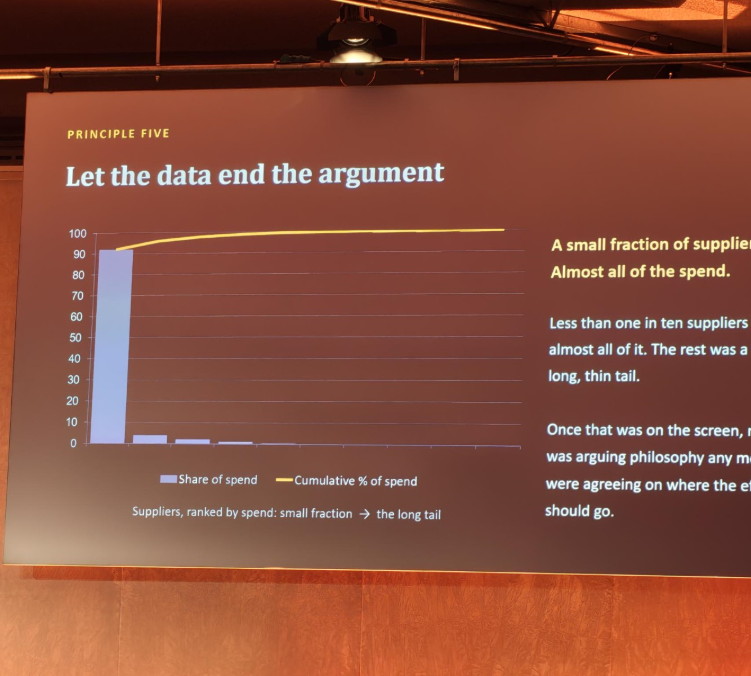
His supplier data showed that fewer than one in ten suppliers accounted for almost all of the company’s spending. Yet the procurement team was spending much of its time managing low-value administration associated with the remaining suppliers.
It highlights a familiar problem.
Procurement processes are often designed around high-value, strategic purchases where detailed sourcing, contract negotiations and risk assessments are entirely appropriate.
But those same processes don’t necessarily make sense for a small software subscription, a one-off service or an urgent operational purchase.
The level of scrutiny should reflect the risk and value of the transaction.
A major supplier contract deserves a thorough review. A relatively small, routine purchase should have a much simpler route, provided the right spending limits and policies are already in place.
When every transaction follows the same lengthy process, procurement teams spend valuable time administering relatively minor purchases while employees become increasingly frustrated.
Neither side benefits.
Two ways to make spending controls work better
Despite the questionable coffee and my new identity as Bill, I left the conference with two ideas that I think are worth bringing into any finance transformation conversation.
1. Start measuring the steps in your purchasing process.
Most finance transformation programmes focus on efficiency, automation and cost savings. I’d add another measure: how many steps does an employee need to complete before a purchase is approved, paid for and visible to finance?
Count every form, click, approval and handoff. Then look at how long the complete process takes.
These are the things employees experience when they need to buy something. Every unnecessary step adds friction and makes the workaround that little bit more attractive.
2. Give everyday spending a simpler route.
Low-value, routine purchases shouldn’t require the same level of administration as major supplier contracts.
Pre-approved budgets, clear spending limits and policies applied at the point of purchase can help employees get what they need while maintaining financial oversight.
That gives Procurement more time to focus on strategic suppliers, commercial risk and larger contracts, while Finance retains visibility over spending as it happens.
The goal is to make following the rules easier than finding a way around them.
Would your spending process pass the Friday afternoon test?
The problem with workarounds is that they often appear to solve an immediate problem.
An employee gets the software they need. A project moves forward. A supplier gets paid. Everyone carries on.
But the administrative work hasn’t necessarily disappeared. It often lands somewhere else, usually with Finance or Procurement, when somebody has to investigate the transaction, find the receipt and work out how it fits into the budget.
Multiply those situations across 52 Friday afternoons and you have a growing collection of purchases that nobody planned to manage that way.
Rob’s test is useful because it forces us to think about spending controls from the perspective of the person who actually needs to make the purchase.
So here’s a question worth taking back to your finance or procurement team.
Imagine it’s 4.30 pm on a Friday. Someone needs to make a legitimate business purchase before the weekend.
Would they follow your process, or would they find a way around it?
If the answer is the latter, I’d be looking at the process before sending another policy reminder.